Showing posts with label solar water heater. Show all posts

Solar Radiation Data necessary to go Solar

0 التعليقات
when you decide going solar it's easy to pay for a specialist to install your solar device, but if you want to do it yourself, you are now in the right place.
there are two issues to know as a start.
1st: what is solar radiation and what data you will need? Answered in this topic.

2nd: position and best angle for solar panels or solar device to install? see here

simply...to answer the first question (solar radiation data). we need first to know What is solar radiation?
The Earth receives energy from the sun by way of radiated energy. This radiated energy is carried by tiny particles having no mass called photons. Photons behave like waves and, as such, have a characteristic wavelength, frequency, and energy. It is the energy of these photons that is used in photovoltaic cells to excite electrons so that an electrical current can be produced.

All energy carried by photons is referred to as electromagnetic (EM) energy and spans all possible values for wavelength and frequencies. Ranges of this spectrum—from shortest wavelength to longest—are referred to as gamma rays, X-rays, ultraviolet, visible light, infrared, microwaves, and radio waves.


However, different types of stars produce differing amounts of energy in each region of the spectrum. Our sun emits more photons in the visible light and surrounding regions than in any other part of the EM spectrum. This phenomenon may be why our eyes have evolved to see that part of the EM spectrum and not microwaves, gamma rays, or any of the other wavelengths that are emitted at lower intensities by our sun.


The Earth’s atmosphere protects us from the higher-energy forms of light, such as ultraviolet rays. In fact, the existence of life on Earth would be far less likely if these more damaging forms of energy were more abundant. The terrestrial spectrum in Left Figure describes the light that actually reaches the Earth’s surface after passing through the atmosphere. Notice that there are various wavelengths in which the number of photons is greatly reduced as compared to the space solar spectrum. This difference is due to photons being absorbed by atmospheric gases, the best known being ozone (O3), which absorbs higher-energy (lower-wavelength) ultraviolet light below 400 nm. Photons with wavelengths near 900, 1100, and 1400 nm are absorbed by water vapor in the atmosphere.

Now, how can we measure solar power (solar flux)? It's measured by the unit (Watt/m2) or (Btu/ft2*h) depending on the unit used commonly in your country.
To measure it - there is a digital device called (Solar power meter)
It's shown in the Left figure and it has also other shapes but this one is common.
by using solar power meter you can measure solar power per square meter The sun gives at the moment and place you are now.(Watt/m2) Of course the amount of power changes by time all over the day.

If you want to be a professional it's recommended to own one - It's easy to get one online from a trusted market like Amazon and we recommend This solar power meter to you.
But is there any other way to know nearly the solar power per square meter amount without owning a solar power meter? Of course yes. But you can't get an exact number with it. You can get a range.
Look at the annual world solar energy map below.

You can see that each color represents a range of energy that the place collects all over the year with the unit (KWh/m2) per year.
and to get more accurate number I recommend you to use this online tool.
If you have a problem with understanding any thing feel free to let your comment.

We never forget to recommend you that having a clean world and powerful energy sources is the responsibility of all of us. So as you are here you must play your role by sharing this topic with your friends. We know that your dream is to see our world as a large solar city.

Read More »

Solar Installation

0 التعليقات
One of solar energy facts  that the position of the sun in the sky changes from hour to hour, day to day, and year by year. While this might be interesting, it is not very helpful to prospective solar energy users— where exactly do we point our solar device?
How the position of the sun changes over the day
If you dig a stick into the ground, you will see that as the sun moves through the sky, so the shadow will change Figure below.In the morning the shadow will be long and thin; however, toward the middle of the day, the position of the shadow not only changes, but the shadow shortens. Then at the end of the day, the shadow again becomes long.
Of course, this effect is caused by the earth spinning on its axis, which causes the position of the sun in the sky to change relative to our position on the ground.
solar installation- solar city

How the position of the sun changes over the year
The earth is slightly tilted on its axis; as the earth rotates about the sun on its 3651⁄4 -day cycle, different parts of the earth will be exposed to the sun for a longer or shorter period. This is why our days are short in the winter and long in the summer.
The seasons in the northern hemisphere will be exactly the opposite to that in the southern hemisphere at any one time.

We can see in Figure below that because of this tilt, at certain times of year, depending on your latitude you will receive more or less sunlight per day. Also if you look at your latitude relative to the sun, you can see that as the earth rotates your angle to the sun will be different at any given time of day, depending on the season.
solar installation-solar city

We can see in Figure below an example house in the southern hemisphere we can see that the sun shines from the north rather than the south . . . obviously if your house is in the northern hemisphere, the sun will be in the south!
solar city and seasonsThis graphically demonstrates how the sun’s path in the sky changes relative to your plot at different times of year, as well as illustrating how our rules for solar positioning are radically different depending on what hemisphere we are in. What does this mean for us?
Essentially, it means that we need to change the position of our solar devices if we are to harness the most solar energy all year round.
 

Which direction should my solar device face?
Regardless of where you are on the planet and regardless of the time of year, the sun will of course always rise in the east and set in the west. Let’s say that you live in the northern hemisphere therefore, the sun is above the equator, your solar panels will work best if they are south facing. This is because they will be facing the sun all day long. North facing panels will be facing away from the sun and will be inefficient.

What is the best angle for my solar device?
Whilst everyone can easily agree upon the optimum direction for solar panels, the question of angle of tilt is less straightforward. On the equator it is simple – horizontal is best as the sun will be directly above. At the poles the sun will always be near to the horizon so vertical is best. At other latitudes, such as Egypt, the sun will appear at a different angle relative to the Earth at different times of year (i.e. it will be lower in the sky in winter and higher in summer). This means that if you point your device at where the sun will be at midday on the summer solstice (midsummer) then you may maximize summer efficiency but you’ll lose out in winter when your array will be pointing “over” the sun.

For the Northern hemisphere, your device should be facing as close to south as possible.
In the Southern hemisphere, you want to orientate your solar device to the North.

The best angle for your solar panels to be at is the angle of your latitude.
solar city installation
You can also set your solar device for optimum performance in summer and winter. In summertime, the solar panel should be at a lower angle. This is because the sun is higher over head.
In wintertime, the sun moves across the sky at a lower angle. So by angling your solar panels higher, you will catch more sun rays.

If you plan to adjust your solar array tilt angle seasonally, a good rule of thumb is:
  • latitude minus 15° in the summer
  • latitude in the spring/fall
  • latitude plus 15° in the winter
The latitude of some cities for example:
Cairo Egypt : 30.04449
New York USA :40.7143528
London UK : 51.5112139

Keeping your solar panels out of the Shade
Shade is the thing that will have the biggest negative effect on the efficiency of solar device, and it can even cause damage. Before deciding how to position them therefore you should assess the area to see whether there are any surrounding structures or trees as well as moving throughout the day, shadows will be in different positions throughout the year due to changes in the angle of the sun, so if you are in doubt you may need to make an assessment over a six month period in order to see the full range of shadows. You’ll also need to check at different times of the day.
There are computer models available that will give a virtual picture, which would avoid the need to measure over an extended period.

Solar tracking devices
The best way to ensure that you get maximum efficiency from your solar panels is to use a solar tracking device. A dual axis system (one that tracks the sun across the sky and adjust the angle of the panels according to the height of the sun in the sky) could increase efficiency by 30% – 40%. Such systems are expensive however and it may be more cost effective to either purchase additional panels or simply accept the lesser efficiency of a fixed array.
As well as the initial expense, solar tracking devices tend to need more maintenance than fixed arrays because they have more moving parts.

SunAs you saw making our world a big solar city isn’t very difficult; Just little knowledge, little experience and a lot of work then it could be done .Winking smile

Read More »

Solar water heater system (solar collectors)

1 التعليقات
Basics
- Solar water heating systems include storage tanks and solar collectors.
- There are two types of solar water heating systems: Active, which have circulating pump and controls, and Passive, which don’t.
- Most solar water heaters require a well‐insulated storage tank.
- Solar storage tanks have an additional outlet and inlet connected to and from the solar collector.
- In two‐tank systems, the solar water heater preheats water before it enters the conventional water heater.
- In one‐tank systems, the back‐up heater is combined with the solar storage in one tank.

  • Solar Collectors


Four types of solar collectors are used for residential applications:
Flat‐plate collector

Integral collector‐storage systems

Batch system

Evacuated‐tube solar collectors

Flat‐Plate Collector
Flat plate collectors are designed to heat water to medium temperatures (approximately 140 degrees Fahrenheit).
solar water heater system- solar collector
Flat plate collectors typically include the following components:
1.Enclosure: A box or frame that holds all the components together.
2.Glazing: A transparent cover over the enclosure that allows the sun’s rays to pass through to the absorber. Most glazing is glass but some designs use clear plastic.
3.Glazing Frame: Attaches the glazing to the enclosure. Glazing gaskets prevent leakage around the glazing frame and allow for contraction and expansion.
4.Insulation: Material between the absorber and the surfaces it touches that blocks heat loss by conduction thereby reducing the heat loss from the collector enclosure.
5.Absorber: A flat, usually metal surface inside the enclosure that, because of its physical properties, can absorb and transfer high levels of solar energy.
6.Flow Tubes: Highly conductive metal tubes across the absorber through which fluid flows, transferring heat from the absorber to the fluid.

Integral Collector Storage (ICS) Systems
In other solar water heating systems the collector and storage tank are separate components. In an integral collector storage (ICS) system, both collection and solar storage are combined within a single unit. Most ICS systems store potable water inside several tanks within the collector unit. The entire unit is exposed to solar energy throughout the day. The resulting water is drawn off either directly to the service location or as replacement hot water to an auxiliary storage tank as water is drawn for use.
solar water heater system- solar collector- solar city


Batch System
solar water heater system- solar collector- solar - city

-->
The simplest of all solar water heating systems is a batch system.
It is simply one or several storage tanks coated with black, solar-absorbing material in an enclosure with glazing across the top and insulation around the other sides.
It is the simplest solar system to make. When exposed to sun during the day, the tank transfers the heat it absorbs to the water it holds.
The heated water can be drawn directly from the tank or it can replace hot water that is drawn from an interior tank inside the building.

Evacuated Tube Solar Collectors
This type of system features parallel rows of transparent glass tubes. Each tube contains a glass outer tube and metal absorber tube attached to a fin. The fin’s coating absorbs solar energy but inhibits radiative heat loss. These collectors are used more frequently for commercial applications.
solar water heater system- solar collector- solar-city
solar water heater system- solar collector- solar  city


Evacuated-tube collectors generally have a smaller solar collecting surface because this surface must be encased by an evacuated glass tube. They are designed to deliver higher temperatures (approximately 300 degrees Fahrenheit). The tubes themselves comprise the following elements:

1.Highly tempered glass vacuum tubes, which function as both glazing and insulation.

2.An absorber surface inside the vacuum tube. The absorber is surrounded by a vacuum that greatly reduces the heat loss.

Read More »

Passive Solar Water Heater

0 التعليقات
Passive solar water heaters rely on gravity and the tendency for water to naturally circulate as it is heated.
Passive solar water heater systems contain no electrical components, are generally more reliable, easier to maintain, and possibly have a longer work life than active solar water heater systems.
The two most popular types of passive solar water heater systems are: Integral-Collector Storage (ICS) and Thermo syphon systems.
passive solar water heater
In an integral collector storage system, the hot water storage system is the collector. Cold water flows progressively through the collector where it is heated by the sun.
Hot water is drawn from the top, which is the hottest, and replacement water flows into the bottom. This system is simple because pumps and controllers are not required.
On demand, cold water from the building flows into the collector and hot water from the collector flows to a standard hot water auxiliary tank within the building.
A flush‐type freeze protection valve is installed in the top piping near the collector.
As temperatures near freezing, this valve opens to allow relatively warm water to flow through the collect to prevent freezing.
In areas of the country, the thermal mass of the large water volume within the integral collector storage collector provides a means of freeze protection.


passive solar water heater - solar city
-->
As the sun shines on the collector, the water inside the collector flow‐ tubes is heated. As it heats, this water expands slightly and becomes lighter than the cold water in the solar storage tank mounted above the collector. Gravity then pulls heavier, cold water down from the tank and into the collector inlet. The cold water pushes the heated water through the collector outlet and into the top of the tank, thus heating the water in the tank.
In a thermosiphon system there is no need for a circulating pump and controller. Potable water flows directly to the tank on the roof. Solar heated water flows from the rooftop tank to the auxiliary tank installed at ground level whenever water is used with the building.
The thermosiphon system features a thermally operated valve that protects the collector from freezing. It also includes isolation valves, which allow the solar system to be manually drained in case of freezing conditions, or to be bypassed completely.
passive solar water heater -- solar city
PRESSURE GAUGE
Is used in indirect systems to monitor pressure within the fluid loop. In both direct and indirect systems, such gauges can readily indicate if a leak has occurred in the system plumbing.
VACUUM BREAKERAdmits atmospheric pressure into system piping, which allows the system to drain. This valve is usually located at the collector outlet plumbing but also may be installed anywhere on the collector return line. The vacuum breaker ensures proper drainage of the collector loop plumbing when it is either manually or automatically drained. A valve that incorporates both air vent and vacuum breaker capabilities is also available.ISOLATION VALVESThese valves are used to manually isolate various subsystems. Their primary use is to isolate the collectors or other components before servicing.

DRAIN VALVES
Used to drain the collector loop, the storage tank and, in some systems, the heat exchanger or drain-back reservoir. In indirect systems, they are also used as fill valves. The most common drain valve is the standard boiler drain or hose bib.

CHECK VALVES
Allow fluid to flow in only one direction. In solar systems, these valves prevent thermosiphoning action in the system plumbing. Without a check valve, water that cools in the elevated (roof-mounted) collector at night will fall by gravity to the storage tank, displacing lighter, warmer water out of the storage tank and up to the collector. Once begun, this thermosiphoning action can continue all night, continuously cooling all the water in the tank. In many cases, it may lead to the activation of the back-up-heating element, thereby causing the system to lose even more energy.

FREEZE-PROTECTION VALVES
Are set to open at near freezing temperatures, and are installed on the collector return line in a location close to where the line penetrates the roof.
Warm water bleeds through the collector and out this valve to protect the collector and pipes from freezing. A spring-loaded thermostat or a bimetallic switch may control the valve.
TEMPERATURE GAUGESProvide an indication of system fluid temperatures.
A temperature gauge at the top of the storage tank indicates the temperature of the hottest water available for use.
Temperature wells installed at several points in the system will allow the use of a single gauge in evaluating system operation.

Read More »

Homemade Solar Water Heater Results.

0 التعليقات
Welcome to new topic from www.solar-city.net. In the previous topic I put my homemade solar water heater execution method with full description in your hands. Now is the time for measurements and results. Let’s get started.

homemade solar water heater - thermocoupleOk. Now the first thing to know is Thermocouple ( the simple way we can use to measure temperature at different places and different times.)
A thermocouple is a device consisting of two different conductors (usually metal alloys) that produce a voltage, proportional to the temperature difference, between either ends of the two conductors. (one end of each conductor is welded with mercury and this is the point that we fix on the place which we want to measure it’s temperature.)

I think I’ll make a topic about thermocouple soon.

We fixed thermocouples at different places to take the temperature measurement.
homemade solar water heater - -thermocouple- solar city

homemade solar water heater- measure devices- solar city
Measurement Results:
I’ll give you average results of 7 days . You must know that readings will change from place to another according to latitude .

- Flux average result.( From 10 am to 5 pm)
homemade solar water heater- measure devices-- solar city

Inlet water temperature, outlet water temperature and tank temperature .along day (From 10AM to 5PM)
homemade solar water heater- results-- solar city

Now as u see It’s very effective and I think the next one could has more efficiency .
wish you find my homemade solar water heater informative to you and feel free to let you comment or question .
Now excuse me I’m going to have my showerBe right back.

Read More »

Homemade Solar Water Heater

0 التعليقات
Welcome to new topic of www.solar-city.net . In this topic I’m going to put my homemade solar water heater in your hands. Wish you will find it helpful. First thing to know is that the total budget of my solar water heater was 460$. It was a simple design to see if I can take my shower with solar energy
homemade solar water heater www.solar-city.net

Work Theory :
home made solar water heater - solar city
When we fill the tank with water we also fill the tubes as shown on figure so water can make free move through them.
When water heated it makes natural move upwards as its density decreases.


homemade solar water heater-solar city
Inside the tank I fixed a coil .
The two ends of the coil were made to get out of the tank .
Cold water enters from one end and we get hot water from the other end.
The heat exchanging happens between the cold water inside the coil and hot water outside the coil (in the tank )

home made solar water heater - black tubes


A black surface heats up quickly.
So I used eight black tubes to heat the water inside them .

Each one of these tubes is opened from one side witch is connected to the thermal store tank.


Assembly on Solid works ( CAD Program )

homemade solar water heater assembly

Ok. Now I’m going to talk about each part :1- Tubes
2- Thermal Storage Tank
3- Insulating Tank
4- The Coil
5- The Carriers
6- Solar Collector
7- Fittings

Let’s get started
-Tubes

I cut two long tubes of 2 inches diameter to 8 pieces
Each piece is 1.5 m long and blocked one side of each piece and I gave the tubes a black color to absorb high amount of heat.(the 8 tubes shown on the right figure)
homemade solar water heater - solar city

homemade solar water heater  tubes- solar cityI welded screwed cylinder to each tube in order to be able to fit it with the tank
.


(Orange circle on the left figure )


- Thermal storage tank


homemade solar water heater - thermal storage tankhomemade solar water heater -thermal storage tank


It is made of steel sheets .
It was rounded to form the shape of the tank then welded and as you can see before welding I made rounded holes (where the tubes will be ) then I welded small screwed cylinders in order to be able to fit tubes with the cylinders.

homemade solar water heater - thermal storage tank - solar cityThe tank then was covered from inside and
outside with some material to avoid
corrosion as shown on the figure .


- Isolate tank

homemade solar water heater - isolation - solar city
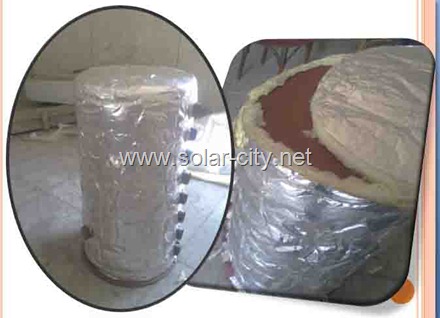
For isolating the thermal storage tank I used
fiber glass layers in order to try stopping heat transfer by convection, conduction or radiation.

homemade solar water heater - isolation -solar city

- The coil

 homemade solar water heater cupper coilIt is 15 m long copper coil.
Outer diameter 0.5 Inches .
Inner diameter 0.3 Inches .
It was rounded as a helical shape with desired diameter to enter the tank (400mm Diameter)

Why I used a copper coil ?
Cause copper has good thermal characteristics

It works as heat exchanger between Hot water inside the tank and the Cold water comes from the outside
By the way >>this is me in the picture Flirt male


- Carriers

homemade solar water heater carriers
The tank is carried by Two Stands one of them is shown in the figure.


- Solar Collector

As we see the eight tubes are connected to the thermal storage tank .
The collector was made of wood and covered with aluminum sheets to reflect sun rays.


homemade solar water heater - collector- solar cityhomemade solar water heater collector
The solar collector was fixed by the two rods as shown on the right figure.


About the angel and position to fit the collector it changes from place to another so I’m going to make a topic telling you how to find the perfect angel and direction of your solar device .


homemade solar water heater - solar collector - glass

Then I covered the house with glass and
insulated it well from all sides in order to
avoid losing heat by convection.


- Fittings
 

homemade solar water heater - fittings- solar city

homemade solar water heater  -solar city

homemade solar water heater
After I were sure that there is no Leaking in the tank . The cover was then insulated using fiber glass like the other sides of the tank .


homemade solar water heater  --solar city

homemade solar water heater- total view - solar city

In the next topic I’m going to talk about measurements and results . I’m going to show you how it is effective and now I’m going to have my shower.Winking smile

Thank you and wish you interest my homemade solar water heater ^_^

-->


Read More »